
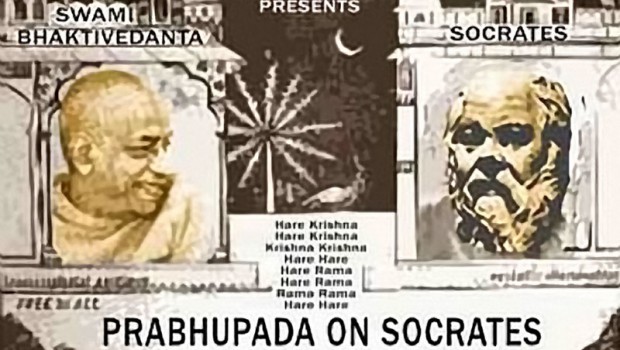
Prabhupada on Socrates Part One
Yes. That is our opinion. Beauty, knowledge, strength and opulence—everything—they are transcendental. Here, in this material world, it is perverted reflection. Just like the example is the mirage. A fool, animal, is thinking there is water in the desert, and he is running after it, and after sometimes he dies of thirst because there is not. But a sane man knows there is no water;…
Hayagriva: …Once a student of Socrates—this is a section on Socrates—said, “I cannot refute you, Socrates.” To this Socrates replied, “Say rather that you cannot refute the truth, for Socrates is easily refuted.” This is by way of saying that the Absolute Truth is not a subject of mental speculation or personal opinion. The Truth, or the good, for Socrates stands separate from mundane relativities or personal opinion.
Prabhupada: That is our opinion. We accept Krishna as the supreme authority, and therefore we cannot refute what Krishna says. And our philosophy is perfect because we follow Krishna. He is the Supreme Perfect. This is our position. In other religious system, taking it our Krishna consciousness movement religious… It is religious, because our religion means the…, to carry out the order of God. That is the sum and substance of religion. We don’t manufacture religion, and neither religion can be manufactured. Manufactured religion is useless. That has been described in the Bhagavad-gita, er, Srimad-Bhagavatam as dharma kaitava. Means cheating. So this is not cheating religion. Our basic principle is dharmam tu saksad bhagavat-pranitam [SB 6.3.19]. Dharma means the order which is given by God, and if you execute that, that is dharma. Just like law. Law is given by the government. You cannot manufacture law. That is not law. So our perfection is there, how we are executing the order of God cent percent. One who has no conception of God, neither the order of God, they can manufacture religious system. But our system is different.
Hayagriva: (aside:) This is picking up fine, the reading? Socrates considers the contemplation of beauty to be an activity of the wise man, but relative beauty in the mundane world is simply a reflection of absolute beauty. In the same way, good in the relative world is simply a reflection of the absolute good. In either case, absolute good or beauty is transcendental.
Prabhupada: Yes. That is our opinion. Beauty, knowledge, strength and opulence—everything—they are transcendental. Here, in this material world, it is perverted reflection. Just like the example is the mirage. A fool, animal, is thinking there is water in the desert, and he is running after it, and after sometimes he dies of thirst because there is not. But a sane man knows there is no water; it is simply a reflection by the sunshine, and this foolish animal is running after it. So he does not…, a sane man does not go for this false water. But another thing is that because there is no water in the desert, it does not mean there is no water. Water is there, but not there. Similarly happiness, beauty, opulence—everything is there. That is in the spiritual world. Here it is only a perverted reflection. So generally people have no information of the spiritual world; therefore they imagine something God, something spiritual world. They do not take that “This is imagination, this material world.” When Krishna says, tyaktva deham punar janma naiti mam eti [Bg. 4.9], they are reading Bhagavad-gita, but this simple thing they can not understand, that a devotee of Krishna, after giving up this body—the body has to be given up—then what happens? Krishna says mam eti, “He come to Me.” And other system says that after death he goes to hell or goes to heaven. So that is to some extent fact. This human life, if he understands Krishna, he goes to the eternal abode—you can take it as heaven or something. Otherwise he remains in this material world to undergo the same cycle of birth and death. That is hell. It can be taken in that way.
Hayagriva: According to Socrates, the pursuit of man is the seeking of this absolute good. Basically Socrates is an impersonalist because he does not ultimately define this absolute good as a person, nor does he give the absolute good a personal name. He just calls it “the good.”
Prabhupada: That is preliminary stage of understanding the Absolute. Because the…, the beginning, Brahman realization, impersonal, and then further advanced Paramatma realization, localized, God is everywhere. And God is everywhere, that’s a fact. That is God. But He has got His place, abode. That is God, that goloka eva nivasaty akhilatma-bhuto [Bs. 5.37], that God is Person, He has His own abode, He has his own associates and everything. Difference is that although He is in His abode, He is present everywhere, even within the atom. Andantara-stha-paramanu-cayantara-stham. So Socrates or any other philosopher, they cannot understand the potency of God, how He can remain in His own place, simultaneously in every atom. That is the conception of God. So everywhere He is staying. Everything is His expansion, His energy, the bhumir apo ’nalo vayuh kham mano buddhir eva ca. The material world is bhumir apo ’nalo vayuh—land, water, earth, air. So these are different expansion of God’s energy. So He can be present everywhere because His energy is expanded everywhere. So energy and the energetic, they are not different, but at the same time energy is not the energetic. This simultaneously one and different, acintya-bhedabheda-tattva, this is perfect philosophy.
Hayagriva: For Socrates, he taught a kind of a process of liberation. For him, liberation meant freedom from passion.
Prabhupada: Freedom from?
Hayagriva: Passion, passion.
Prabhupada: Passion, yes.
Hayagriva: And his motto was, “Know thyself.” And by knowing oneself through meditation or insight one can gain self-control, and by being self-controlled one can attain happiness.
Prabhupada: Yes, that is a fact. Meditation means to analyze oneself—that is real meditation—and find out the Absolute Truth. That is the description in the Vedic literature. Dhyanavasthita-tad-gatena manasa pasyanti yam yogino. Yogi means by his meditation he is seeing the Supreme Truth, Krishna, or God, within himself. Krishna is there, and so a yogi consults Krishna, and Krishna advises him. That is the relationship with yogi. Buddhi-yogam dadami tam. One who is purified, he is seeing Krishna always within himself. That is confirmed in the Brahma-samhita, premanjana-cchurita-bhakti-vilocanena santah sadaiva hrdayesu vilokayanti [Bs. 5.38]. A saintly person, advanced, he is seeing Krishna, yam syamasundaram. The very word used, Krishna is syamasundaram, very beautiful blackish, the Personality of Godhead, Syamasundaram. Syama means blackish, but extraordinarily beautiful. That is called syama. Premanjana-cchurita-bhakti-vilocanena santah sadaiva hrdayesu vilokayanti yam syamasundaram acintya-guna-svarupam [Bs. 5.38]. Acintaya, unlimited qualities. Govindam adi-purusam tam aham… He is govindam. So it can be realized that He is situated everywhere, at the same time in His person He is always engaged in Vrndavana dancing with the gopis and playing with His friends and talking with His mother, and sometimes as naughty boy He is teasing mother’s household affairs. So this is Krishna.
Hayagriva: It’s been said that Socrates’s philosophy is primarily a philosophy of ethics, and that…
Prabhupada: Atheist?
Hayagriva: Ethics, ethics…
Prabhupada: Ethics.
Hayagriva: The way, the way to…
Prabhupada: Ethics, yes.
Hayagriva: The way of action in the world. And the jnana, or knowledge, in itself is not sufficient, but it must be applied and must serve as a basis for action in the world.
Prabhupada: Yes, ethics is the basic principle of purification. Unless one does…, knows what is moral and what is immoral… Of course, in this material world everything is immoral, but still we have to distinguish good and bad. That is called regulative principle. Simply by following the regulative principle, if he does not reach the ultimate goal of spiritual life, so that is also not wanted. The real aim is to come to the spiritual platform and become free from the influence of these laws of material nature. So passion is the binding force in the material nature. Just like in the prison house the prisoners are kept sometimes chained by some iron shackles and other method, so material nature has given the chain, shackles, of sex life, passion, rajas tamah. Kama esa krodha esa rajo-guna-samudbhavah. Rajah-gunah means the modes of passion. So modes of passion means kama, lusty desires, and krodha. When the lusty desires are not fulfilled, one becomes angry. But these things are the means of bondage in this material world. In another place it is said, tada rajas-tamo-bhavah kama-lobhadayas ca ye [SB 1.2.19]. When one is afflicted with the base material modes of nature, namely rajo-guna and tamo-guna, then he becomes greedy and lusty. So ethics require to get out of the clutches of greediness and lusty desires. Then he comes to the platform of goodness, which will help him to go to the platform of spiritual life.
Hayagriva: But is meditation in itself…, would that be sufficient to transcend these lower…?
Prabhupada: Yes, meditation, if he seeks after the Supersoul within himself…
Hayagriva: Oh.
Prabhupada:…that meditation is perfect. And if he is manufacturing something or bluffing others and bluffing himself by…, in the name of meditation, transcendental, it is useless. It has no value.
Hayagriva: Well, he feels that if one knows himself one will be a sadhu, because knowledge is identical with virtue.
Prabhupada: Yes.
Hayagriva: And through meditation—they call…, he called it arete (?)—a person attains knowledge. Through knowledge a person becomes virtuous. When one is virtuous, he acts in the right way. When one acts properly, he becomes happy. Therefore the enlightened man is a man who is meditative, knowledgeable, virtuous and, because of his proper action, he is happy.
Prabhupada: Yes. That is confirmed in the Bhagavad-gita:
brahma-bhutah prasannatma na socati na kanksati [Bg. 18.54].
This is the symptom of self-realized person. If one is self-realized, he is immediately happy, prasannatma, jolly, because immediately he is on the right. Just like one is going on under some mistaken ideas, and when he comes to the real idea, he becomes very happy: “Oh, so long I was going on such a mistaken idea.”
So immediately the result will be happiness: “How foolish I was. I was doing like this, doing like that.” So right…, as soon as one comes to the right position, he, the symptom is he is prasannatma. What is that prasannatma? Na socati na kanksati [Bg. 18.54]. Prasannatma, happiness, means he has no more anything to hanker. Just like Dhruva Maharaja said, svamin krtartho ’smi varam: “I don’t want any material benediction.”
Prahlada Maharaja said, “My Lord, don’t tell You want me for any material benefit. I have seen so much afflict. My father was so big materialistic that even the demigods, they were afraid of him. You have finished it within a second. So I am not after these things.” So this is real knowledge, that na socati na kanksati, he has no more hankering.
The karmis, jnanis, yogis, they have got hankering. The karmis, they are hankering after how to get material wealth, how to get material position, how to get nice woman, how to get nice position. That is karmi. Their business—simply hankering, hankering. Bancruptcy (?). And if they have lost, they cry, “Oh, I have lost it, I have lost it, I have lost.” Two business. So when one becomes self-realized, these two things are conspicuous by absence: no more hankering, no more lamenting. The karmis are hankering; the jnanis, they are also expecting to become one with God, to merge into the existence of God. That is also hankering. The yogis, they are hankering after some magic power so they can befool others that he has become God, “I can manufacture gold, I can fly in the sky,” and foolish people after them. Intelligent person will see, “What is this perfection? Even if he can fly in the sky, there are so many birds are flying. What is the difference between this flying and that flying?” So he doesn’t care. So these are not perfection. But they, people, foolish people, they think it is perfection. If one can say that “I will walk over the sea,” actually say it shall happen, thousands and thousands fools will come. Just as, the same thing, that there is a man advertises that he will show how he can bark like dog, people will pay ten rupees ticket and go to see how a man is barking like a dog. But he doesn’t hear so many dogs are barking, creating disturbance.
So this is going on. Some extraordinary power, showing, making one karmi, jnani, yogi, but a devotee, he is so satisfied in the service of the Lord, he doesn’t want anything, all this nonsense. That is perfection.
Hayagriva: You once mentioned that Greeks, the ancient Greeks were chased out of India where… They were ksatriyas chased out of India by Parasara Muni, something like that. But Socrates was confronted with a society that on one hand included what were called Sophists—these were more or less mental speculators; they were paid money to philosophize or to speculate—and humanists, who said, “Man is the measure of all things.” They…, no belief in God or any higher force; nothing beside man. And with the demigod worshipers, the Greek pantheon of gods were very much like the demigods described in the Vedic literatures, like Zeus was like Indra, and Athena was like Sarasvati. They retained…, the Greeks retained their worship of the demigods, but there is no mention of a Supreme God under whom everyone else served, and Socrates, on…, neglected the worship of these demigods. He felt that there was no use in worshiping the demigods, and he stressed meditation on the self, on the highest good which resides in the heart, which must correspond to the Paramatma.
Prabhupada: Yes.
Hayagriva: And so in teaching this he was teaching something radically different, and this is one of the reasons that he was condemned to death—for blaspheming the demigods, for blaspheming the gods. He felt that the worship of these gods did not lead to self-realization at all.
Prabhupada: Yes. That’s a fact. That is confirmed in the Bhagavad-gita:
kamais tais tair hrta-jnanah tyajante anya-devatah [Bg. 7.20]. They worship other demigods, being too much lusty. Because the demigod is worshiped for some material benefit.
So they have been described as hrta-jnanah. Hrta-jnanah means one who has lost his intelligence. Actually it is so. Suppose by worshiping a demigod, Sarasvati, the goddess of learning, so you get the opportunity of being a, becoming a very nice scholar. But how long you shall remain scholar? As soon as the body is finished, your whole scholarship is finished. Then you have to accept another body, and you have to act according to that body.
So how you have…, this scholarship will help you? But if you worship God, as Krishna says, that janma karma ca me divyam yo janati tattvatah… [Bg. 4.9]. To worship God means to know God, actually what is God, more perfect—how He is managing, how material nature is working under Him.
People cannot even imagine that God can be person, but here is everything person. Mayadhyaksena prakrtih suyate sa-caracaram: [Bg. 9.10] “Under My supervision the material nature is working.” So these impersonalists or less intelligent persons, they cannot understand that how a person can dictate the wonderful activities of the material nature; therefore they remain impersonalist. But actually, person. That is the understanding of Bhagavad-gita. God is person. Mattah parataram nanyat kincid asti dhananjaya: [Bg. 7.7] “There is no more superior authority than Me.” So when He says mattah, that means there is a person, person. So…
Hayagriva: Bhakta.
Prabhupada: Huh?
Hayagriva: Bhakta.
Prabhupada: No, Krishna, God.
Hayagriva: Yes.
Prabhupada: God is person.
Hayagriva: Yes.
Prabhupada: And He says, mattah parataram nanyat kincid asti dhananjaya: [Bg. 7.7] “There is no more superior authority than Me.” Aham sarvasya prabhavo mattah sarvam pravartate [Bg. 10.8]: “I am the origin of everything. Everything emanates from Me.” And the Vedanta-sutra confirms, “The Absolute Truth is that from which everything comes,” janmady asya yatah [Bhag. 1.1.1].
So the Absolute Truth is person, and Arjuna, when he understood Bhagavad-gita, he addressed Krishna, param brahma. That is Absolute Truth. Param brahma param dhama pavitram paramam bhavan [Bg. 10.12]. So really understanding Absolute Truth means to understand His personal feature. He has got three features: impersonal feature, localized feature and personal feature.
So brahmeti paramatmeti bhagavan iti sabdyate. All of them are the same truth, spiritual truth, but different phases or different features. The example is given, just like you see one mountain from a very distant place, very distant place, you see the hazy something like cloud. Then you come nearer, you see something green, there are trees, like that. And if you will come still nearer, you will see, “No. It is not only trees and hazy but there are houses, there are men, there are animals.” So actually the same thing, the mountain from a distant place, but because one is far away from the mountain, he sees the same mountains are impersonal, and if he comes little nearer, then he sees Paramatma, personal within, present everywhere. And when he comes again still, he sees the same person is still there; He is dancing and playing. This is the difference.
Hayagriva: So through jnana, through the path of jnana, Socrates may have realized Brahman, he may have realized Paramatma…
Prabhupada: Yes.
Hayagriva:…but there was no way to realize…
Prabhupada: No, there is way…
Hayagriva:…Krishna.
Prabhupada: …there is way, if he makes further advancement. The same example, the same mountain is there. From a distant place you will say hazy cloud; nearer you see something green, there are trees; and still you go farther, you will see everything perfectly.
Hayagriva: But I thought Krishna can only be realized through bhakti, through…
Prabhupada: Yes.
Hayagriva:…devotion.
Prabhupada: Yes. You can not enter in Krishna’s place without being a purified bhakta. Bhaktya mam abhijanati [Bg. 18.55]. That is stated in the Bhagavad-gita. He never says that by jnana or by karma or by yoga one can understand Him. It is clearly stated, in many sastra, bhaktya mam abhijanati: [Bg. 18.55] only through devotional service one can understand Krishna.
The personal abode of Krishna is especially reserved for the bhaktas. Therefore all jnanis, yogis, karmis, they cannot; they remain outside, that there is the sunshine and the sun. To enter into the sun is not so easy thing, but sunshine anyone can remain. The temperature is not so hot; you can tolerate it. But although the sunshine and the sun not different, in the sunshine, sun globe, if you enter, if you have go the power to enter, the same light and same temperature… Not same, I mean to say, temperature and light. So the temperature of sunshine, light and temperature, is not the same as the temperature and light in the sun globe. [break]
Hayagriva: Now Socrates, as a teacher, in addition to believing in the value of insight or meditation, Socrates also believed that knowledge can be imparted from one person to another. He therefore believed in the role of a guru or teacher, which he himself was for many people.
He believed also in good association amongst people who were interested in self-realization, and he followed the method known as the Socratic dialogue as a means for evoking the truth. Now, he would use a method called Socratic irony, in which he himself, Socrates, would pose himself as an ignorant person and would ask questions of his young disciples. He would never offer the answers, but would try to draw the answers out of his disciples, and this was called the mayudic (?) method. So he considered himself to be a kind of midwife—in fact his mother was a midwife—who would draw the truth from the repository in the soul. He felt that the truth was there within but had to be drawn out, and that the truth is dormant within everyone, that the individual possesses the truth previous to birth in an existence previous to earthly existence.
Prabhupada: Yes. So almost similar to our method, because we advised, we advised in this Vedic principle, that for the truth one must approach a guru. That is the version everywhere. In Bhagavad-gita also, same instruction is there:
tad viddhi pranipatena
pariprasnena sevaya
upadeksyanti tad jnanam
jnaninas tattva-darsinah[Bg. 4.34]
So you have to approach a guru who knows the Absolute Truth. “Knows” means he has seen. Just like in our daily life, direct perception to see something, people argue on that, that “Can you show me God?” That is the tendency, that direct perception.
So the direct perception is possible by advanced devotion. There is no difficulty because, as I have already explained, santah sadaiva hrdayesu vilokayanti. Constantly he is seeing the Supreme Personality of Godhead, Syamasundara. So there is a state when one can constantly see the Supreme Lord as Paramatma sitting within his heart and taking advice from Him. Krishna also confirms this: buddhi-yogam dadami tam. He talks.
So by meditation, if it is actually meditation to search out the Absolute Truth within the heart, then he can meet. That is the yoga practice. Yoga practice means concentrating the mind to see the Supersoul within. Therefore he has to control the activities of the senses from all other engagements. Then it is possible. Yoga practice, this dhyana, dharana, asana, pranayama, these are why? Simply to concentrate the mind, focusing toward the Paramatma, and then, when is perfect, he always sees. Therefore Krishna confirms it in the Bhagavad-gita:
yoginam api sarvesam
mad-gatenantar-atmana
sraddhavan bhajate yo mam
sa me yuktatamo matah
[Bg. 6.47]
“Of all the yogis, one who has learned to see Me within himself, he is first class.” Others are bogus. The perfection of yoga means to see God within himself. That is perfection of yoga.
So this process, as Socrates used to give chance to his disciple, that is good process, to give him chance to develop his understanding. The teacher helps. Just like the father and mother give the child. First of all he helps, taking his hand, “Now walk, walk,” and sometimes he gives him pleasure: “Now you walk. Let me see how you walk. Now you walk.” Although he sometimes falls down, but a father will encourage, “Oh, you are very nice. Stand up, stand up again. Walk.” So give chance to the disciple how they can think properly to go back to home, back to Godhead, teacher is giving instruction and tries to see how he has developed.
So that process is natural. And another process is that suppose a man comes to argue, so you should give him first chance, “All right, you say what is the import of these verses.” Then he can understand his position, where he is. Then he captures him. Because an expert, he knows how to capture the fool. So let the fool first of all go on, talk all nonsense, then he’ll understand where he is and he will capture. That is also a process.
Hayagriva: Socrates, in a very famous allegory or metaphor, pictures humanity living in a dark cave, and the teacher has seen the light outside of the cave. He knows that there’s something outside the cave that is light, and he may return to the cave to tell people in the cave that this is darkness. And the people in the cave, many of them would consider him to be crazy for speaking of such a thing as the light outside of the cave, and that this was a very, conceivably a very dangerous position to be in.
Prabhupada: But actually that is the fact. Just like we are say so many times, Dr. Frog. A frog within the dark well, he is thinking, “Here is everything.” And if he is informed, “Oh, there is big miles of water, Atlantic Ocean,” so this Dr. Frog, from within the well he has never seen the Atlantic Ocean, and he cannot conceive that the water can be so expansive.
So therefore those who are in the dark well, for them it is surprising that what is the light outside. But that’s a fact. And one who has fallen, he is in the…, if he is crying that “I am fallen,” so it is said that the man outside, he drops a rope, that “You catch this rope and I shall take it out.” But he does not catch up.
Just like we are presenting that you, everyone in the material world, you are suffering, you take, catch up this Krishna consciousness. They are refusing, or they do not admit; that is going on. But if one is fortunate, he can catch up the rope, and the man wants to help him, he can get him out. But he has to catch up. It is Krishna’s advice also, that “You are crying, you are suffering, you are finding, trying to find out how your suffering will be ended.” That materialist, they are doing their own way, and the impersonalists, they are doing in their own way; the yogis, they are doing in their own way. Everyone is trying to get out of the suffering. But when Krishna says that these things will not help you, sarva-dharman parityajya mam ekam saranam vraja [Bg. 18.66], he does not catch up.
That is his misfortune. God Himself says that “You take.” “You take Me” means by His instruction in the Bhagavad-gita. “You take to Me, you will be saved.” But they will not. That is their obstinacy. And the Vedas therefore says, tamasi ma jyotir gamah: “Don’t remain in the dark well. You come out to the light.” But they will not come to the light. They want to remain in the dark well. And if you want to become perfect, that is their misfortune.
Within this material world it is darkness, just like the, just now it is evening. It is giving us that actually it is dark. Because Krishna has supplied the sun, moon, therefore it is light. But there is another place where, without sun, without moon, you will get light.
That is stated in the Bhagavad-gita: na yatra bhasayate suryo, na pavakah, like that, there is a na yatra bhasa, tad dhama paramam, “That is My kingdom.” So everything is Krishna’s kingdom, but there is specially, that there is no need of sunshine, there is no need of moonshine, there is no need of electric light; it is all effulgent. So He is giving the information, but these rascals will not take.
They want to make adjustment in the darkness of night. How it is possible? This is teaching also the nature’s way of work. The sun is in the sky, but the arrangement is such that twelve hours it is darkness and twelve hours it is light. But sun is there always. There is no doubt about it. But the arrangement, this is just to convince us that actually it is dark. With the sunshine it is sometimes day and sunny. Similarly, happiness can be by the…, to remain under this sunshine, under the illumination of Krishna. That is happiness, Krishna consciousness. And if you want to be happy in darkness… Just like in darkness at night the only happiness is sleeping and sex, that’s all. There is no other happiness. And when there was dark in New York, electricity failed, and so many women became pregnant. (laughs) Yes.
In the darkness this is the happiness: either you sleep or you enjoy sex. That is happiness. That is material world; therefore it is darkness. That is said in the Srimad-Bhagavatam:
srotavyadini rajendra
nrnam santi sahasrasah
apasyatam atma-tattvam
grhesu grha-medhinam
[SB 2.1.2]
nidraya hriyate naktam
vyavayena ca va vayah
diva carthehaya rajan
kutumba-bharanena va
[SB 2.1.3]
These materialistic persons, they have got many things to hear, srotavyadini, huge, big, big volumes of newspaper, so many rascal information. Why they have got so many engagement? Apasyatam atma-tattvam: [SB 2.1.2] because they do not know what is self-realization. Grhesu grha-medhinam. They think that to live in this family life surrounded by wife, children, friends, this is life. So better use this newspaper and talk all nonsense and waste time. Their engagement is nidraya. At night they sleep or enjoy sex, nidraya hriyate naktam vyavayena, and in daytime they hanker after money, runs the motorcar head-break speed, neck-break speed.
Hayagriva: Breakneck.
Prabhupada: Breakneck. And then what is the business? Searching out some means of food, exactly like the hog, he is loitering here and there, “Where is stool? Where is stool? Where is stool?” And this is going on in the polished way as civilization. There is so much risk, as running these cars so many people are dying. There is record, it is very dangerous. At least I feel as soon as I go to the street, it is dangerous. The motorcar are running so speedy, and what is the business? The business is where to find out food. So therefore it is condemned that this kind of civilization is hoggish civilization. This hog is running after, “Where is stool? Where is stool? Where is stool?” And you are running in a car. The same. Purpose is the same: “Where is stool?” Purpose is the same.
Therefore this is not advancement of civilization. Advancement of civilization is, as Krishna advises, that you require food, so produce food grain. Remain wherever you are. You can produce food grain anywhere, a little labor. And keep cows, go-raksya, krsi-go-raksya vanijyam vaisya-karma svabhava-jam [Bg. 18.44].
Solve your problem like… Produce your food wherever you are there. Till little, little labor, and you will get your whole year’s food. And distribute the food to the animal, cow, and eat yourself. The cow will eat the refuse. You take the rice, and the skin you give to the cow. From dahl you take the grain, and the skin you give to the… And fruit, you take the fruit, and the skin you give to the cow, and he will give you milk. So why should you kill him? Milk is the miraculous food; therefore Krishna says krsi-go-raksya vanijyam vaisya [Bg. 18.44]. Give protection to the cow, take milk from it, and eat food grains—your food problem is solved. Where is food problem? Why should you invent such civilization always full of anxieties, running the car here and there, and fight with other nation, and economic development? What is this civilization? Therefore we require to take to Krishna consciousness to become happy every way—economically, philosophically, religiously, culturally, everything. That is Krishna consciousness.
About the Author

HDG A.C. Bhaktivedanta Swami Prabhupada Founded the Hare Krishna Movement in 1966 in New York. In only 11 years he spread the movement all over the world. He wrote more than 80 books including Bhagavad-gita As It Is, Srimad-Bhagavatam, Sri Caitanya-caritamrta, Sri Isopanisad. Prabhupada's books constitute a complete library of Vedic philosophy, religion, literature and culture.
Related Posts
Bhaktivinoda Thakura’s Appearance Day Lecture, London, September 23, 1969 →
Krishna Consciousness–The Yoga for the Modern Age →
The Cleansing of the Gundica Temple →


Hare krishna Prabhu !
Are there any plans for selling the book “Dialectic Spiritualism” on krishnastore.com
Warm Regards
Hare Krishna
Unfortunately the book “Dialectic Spiritualism” is out of print. If it comes back into print we would very happily distribute it at https://krishnastore.com
Hare Krishna, Hare Krishna!!
You have been blessed by Krishna to have been able to have produced your site and work for us all to find Krishna Consciousness!
Please tell me if there is a quicker way to viewing Srila Swamiji Prabhupadas featured videos 2,3..etc without repeating video 1.
Bless…
Hare Krishna Bob
Thanks for the encouragement. There are still a lot of problems and bugs. It will get better.
The video is coming from http://www.KrishnaTube.com If you go to:
http://krishnatube.com/categories/1/Srila-Prabhupada
You should be able to see all the Prabhuapda Videos and watch whatever you want to. You may have to go on to the next pages to find what you want.