
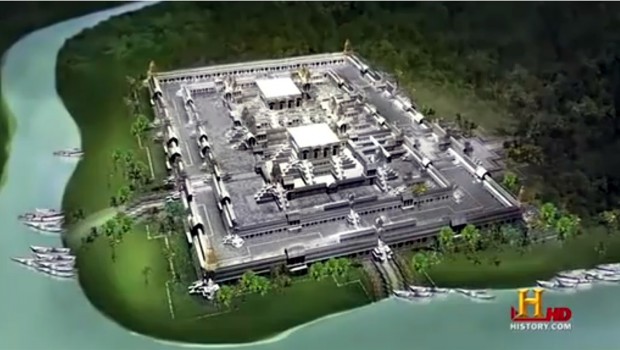
City Under the Sea — Dwarka?
B.K. Parthasarathy writes about a spectacular underwater archaeological find by a joint British-Indian diving team that could rewrite history.
Who would have thought a city that could be older than the Harappan civilization could be lying beneath water right off the coast of Mahabalipuram?
Sometimes, it pays to listen to the stories of humble fishermen. Local fishermen in the coast of Mahabalipuram in Tamil Nadu have for centuries believed in that a great flood consumed a city over 1,000 years ago in a single day when the gods grew jealous of its beauty.
The myths of Mahabalipuram were written down by British traveler J. Goldingham, who visited the town in 1798, at which time it was known to sailors as the Seven Pagodas. Legend had it that six temples were submerged beneath the waves, with the seventh temple still standing on the seashore.
Best-selling British author and television presenter Graham Hancock took these stories seriously. The hypothesis that there may be ruins underwater off the coast of Mahabalipuram has been around at least since the eighteenth century among scholarly circles.
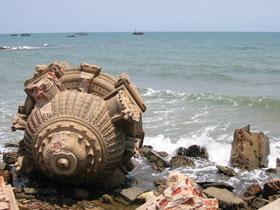 “I have long regarded Mahabalipuram, because of its flood myths and fishermen’s sightings as a very likely place in which discoveries of underwater structures could be made, and I proposed that a diving expedition should be undertaken there,” said Hancock.
Hancock’s initiative resulted in the Dorset, England-based Scientific Exploration Society and India’s National Institute of Oceanography joining hands. In April this year, the team made a spectacular discovery
The SES announced: “A joint expedition of 25 divers from the Scientific Exploration Society and India’s National Institute of Oceanography led by Monty Halls and accompanied by Graham Hancock, have discovered an extensive area with a series of structures that clearly show man made attributes, at a depth of 5-7 meters offshore of Mahabalipuram in Tamil Nadu.
“The scale of the submerged ruins, covering several square miles and at distances of up to a mile from shore, ranks this as a major marine-archaeological discovery as spectacular as the ruined cities submerged off Alexandria in Egypt.
”
India’s NIO said in a statement: “A team of underwater archaeologists from National Institute of Oceanography NIO have successfully `unearthed’ evidence of submerged structures off Mahabalipuram and established first-ever proof of the popular belief that the Shore temple of Mahabalipuram is the remnant of series of total seven of such temples built that have been submerged in succession. The discovery was made during a joint underwater exploration with the Scientific Exploration Society, U.K.”
NIO said:
- Underwater investigations were carried out at 5 locations in the 5 – 8 m water depths, 500 to 700 m off Shore temple.
- Investigations at each location have shown presence of the construction of stone masonry, remains of walls, a big square rock cut remains, scattered square and rectangular stone blocks, big platform leading the steps to it amidst of the geological formations of the rocks that occur locally.
- Most of the structures are badly damaged and scattered in a vast area, having biological growth of barnacles, mussels and other organisms.
- The construction pattern and area, about 100m X 50m, appears to be same at each location. The actual area covered by ruins may extend well beyond the explored locations.
- The possible date of the ruins may be 1500-1200 years BP. Pallava dynasty, ruling the area during the period, has constructed many such rock cut and structural temples in Mahabalipuram and Kanchipuram.
The last claim is questioned by Hancock, who says a scientist has told him it could be 6,000 years old.
Durham University geologist Glenn Milne told him in an e-mail: “I had a chat with some of my colleagues here in the dept. of geological sciences and it is probably reasonable to assume that there has been very little vertical tectonic motion in this region [i.e. the coastal region around Mahabalipuram] during the past five thousand years or so. Therefore, the dominant process driving sea-level change will have been due to the melting of the Late Pleistocene ice sheets. Looking at predictions from a computer model of this process suggests that the area where the structures exist would have been submerged around six thousand years ago. Of course, there is some uncertainty in the model predictions and so there is a flexibility of roughly plus or minus one thousand years is this date.”
If that were true, it would be a spectacular development. Previous archaeological opinion recognizes no culture in India 6,000 years ago capable of building anything much.
Hancock says this discovery proves scientists should be more open-minded. “I have argued for many years that the world’s flood myths deserve to be taken seriously, a view that most Western academics reject. “But here in Mahabalipuram, we have proved the myths right and the academics wrong.”
Hancock believes far more research needs to be done on underwater relics.
“Between 17,000 years ago and 7000 years ago, at the end of the last Ice Age, terrible things happened to the world our ancestors lived in,” he says.
“Great ice caps over northern Europe and north America melted down, huge floods ripped across the earth, sea-level rose by more than 100 meters, and about 25 million square kilometers of formerly habitable lands were swallowed up by the waves.
“Marine archaeology has been possible as a scholarly discipline for about 50 years — since the introduction of scuba. In that time, according to Nick Flemming, the doyen of British marine archaeology, only 500 submerged sites have been found worldwide containing the remains of any form of man-made structure or of lithic artifacts. Of these sites only 100 — that’s 100 in the whole world! — are more than 3000 years old.”
Hancock, who was understandably resentful about the NIO’s silence in his pivotal role in making the diving expedition happen — SES gave him full recognition — was himself quite generous about who deserved the greatest credit:
“Of course the real discoverers of this amazing and very extensive submerged site are the local fishermen of Mahabalipuram. My role was simply to take what they had to say seriously and to take the town’s powerful and distinctive flood myths seriously. Since no diving had ever been done to investigate these neglected myths and sightings I decided that a proper expedition had to be mounted. To this end, about a year ago, I brought together my friends at the Scientific Exploration Society in Britain and the National Institute of Oceanography in India and we embarked on the long process that has finally culminated in the discovery of a major and hitherto completely unknown submerged archaeological site.”
Interested readers can visit the following Web sites for more information. The Scientific Exploration Society’s Web site at http://www.india-atlantis.org/
And Graham Hancock’s Web site at http://www.grahamhancock.com/
– B.K. Parthasarathy is a freelance writer based in Chennai.
Reference: http://www.siliconeer.com/may2002.html
About the Author

Related Posts

Just Give Them Chance to Hear About Krishna (MP3 Audio) →

The Purpose of the Krishna.org Website →

Letter to a Buddhist about his “empty mind” philosophy →



Why Lord Krishna Abode was taken away by sea?
Read Srila Prabhupada’s Srimad-Bhagavatam and find out for yourself.
Applause???????? CONGRADULATIONS TO YOU ALL!!!! I have followed the works of Graham Hancock for over 20 years now and he is an amazing man. He has sacrificed very much of his personal life to educate and open up the minds of all peoples globally. Through his research and devotion to us all he has PROVEN BEYOND A SHADOW OF DOUGHT that our history books need to be rewritten!! Mainstream archeological dating is to say the least WRONG and needs to be updated for the sakes of our children and the future generations following them. We live our lives in a world where MEDIA dictates the “who, what, where and when’s” of our past and this “must change”; it has to; otherwise we are all victims of ignorance. If you disagree with me then do YOURSELF a favor. Check out Graham Hancocks website and read for YOURSELF any (even just one) of his books or listen to (even just 1) lecture he presents then do your own research and compare. Many of you will be “Shocked” that what you have been taught DOES NOT make sense but that’s ok because TOGETHER AS A WHOLE WE A PEOPLE CAN EDUCATE OTHERS IF ONLY WE EDUCATE OURSELVES. KNOWLEDGE IS POWERFUL AND SO ARE YOU.
Good work by historical dept but main thing cuase of this insident by require more search why under ground old city because nearly realise this inside may be in khambhat akhat
lord krishna is the wonders of the universe
lord krishna is one of the wonders of the universe
Hare Krishna at last you perished at dwaraka in the deeper place of the see at Gujarat where we beleived that you lived there.
a man never become a god i mean GOD
We felt very happy to listened Krishna mystery.
Please broadcast this whole information into our region languages , many people are illiterates and unable to understand English language.We are thanking you a lot . Namaskaram !
yours sincerely ,
Pulakandam Jayaprakash Sharma.
Its very interesting..and I believe these are all so true
When India is free from Corruption?
Please comment on the why the ice melted in the last ice age? It is nice that scientist are finding whole city’s under the water that were above water at one time. Which clearly means water levels were lower 7,000 years ago than now. Let’s move on to the real story. Let’s ask the real question, “why is there an elephant standing in the middle of the rooom”.
What melted the ice? Was it because man had global warming problems back then too. Was it because man was using cars running on evil carbon dioxide fossil fuels to cause a green house gases effect. NO!.
Finally the gig is up. We as mankind are not causing global warming. Yes we pollute, but that is not why the earth is warming up or cooling down. The science is in. Stop believing a lie and start believing in facts. Solar flares, Volcano’s, the Earths Axes moved, meteor hits, Sun spot, are just to name a few on why the earth heats up or cools down. It might even be simpler than that, it could be, “that is what the earth does all on its own.”
Wind power is nice, solar power is nice, even nuclear power is nice. But don’t say we have to use alteratives fuels to oil because the sky is falling.
Have a brain and don’t let the con men of global warming fool you. Let the light bulb go off in our heads and finally say, enough is enough.
This is all I can do to help out with society evolution. Thank you very much for reading my input. From your local Science monitor. Tony C.
I would like to know more about the sunken city off the shore from Bombaywhich is reported to be 10.000yrs old.Also i would like to know if the remains of cities beneath the dead sea have been further investigated.I saw a tv programme that claimed that there were a number of dome shaped roofs on the sea bed.Further investigation was brought to a halt because of civil unrest.Are any further plans to find out if they are the possible ruins of Sodum & Gommorah.This is what was thought by the diving team untill the were forced to stop by the government at the time.Please let me know more.Looking forward to your reply.Yours.Tony Welby.
all monuments and underwater pyramids archeological research must definitely be
done on the divine stone of lord vishnu i would request
B.K. Parthasarathy to write more about a spectacular underwater archaeological find by a joint British-Indian diving team that could rewrite history.
we can only keep in mind that super power supreme personality of godhead
lord krishna resides everywhere. the act of god : impact of floods,Tsunami, accured time immemorial througout indian ocean burring many anciant towns, cities, include mamalapuram, ramasetu, navagraha temple rameshvaram.
GOD IS ALMITY AND POWERFUL JAI SHREE KRISHNA
Hancock’s initiative resulted in the Dorset, England-based Scientific Exploration Society and India’s National Institute of Oceanography joining hands. In April this year, the team made a spectacular discovery
I THINK IT SHOULD BE RE-CONSTRUCTED AS A MONUMENT
IN mahabalipuram in Tamil Nadu.
LORD VISHNU RESIDES IN THE MONUMENT
AS PER THE SCRIPTURES
ONE SHOULD MAKE A TEMPLE WHICH CAN BENEFIT THE COMPLETE STATE AND THE
COUNTRY .
Please be kind to publish relative photographs of said ruwins to see us. i think it will help to all Thanks – Sarath
Because of multifarious sins committed by the earlierest athiest & idol
worshippers ,Homos & the like ALMIGHTY GOD had destroyed many town & cities decipted in the Muslims’s Holy Scripture.
So you can discover many destroyed objects or cities underneath,
Thank You.
Its not because of athiest and those who oppose the idol worshippers, there were tsunami, earthquake etc etc. its because of those sinners who worship and do sincerely sin knowingly and continuously. Because Nature is Nature and because nature worship was changed and then idols occupied the place for profit the natural “nature” calamities started. Why cant the real god punish the athiest alone and make the thiest happy, why should he be giving punishment to all? unfair justice! But one fact is real that is destiny thats written for all, even God can not change his decision, written is written!. You will accept my points in future. When God himself is rich and the omnipotent why do temples have boxes to be filled with money and jewels, can’t you identify the sinners? You try to understand the real fact for earthquake.
[…] (Egypt) discovered just 16 years ago, underwater pyramids near Okinawa (Japan) , temples in a sunken city in India and more recently in Port Royal (Jamaica) a city that was claimed by the sea in […]
jai gurupadar,
please make an article on the devine stone of vishnu (the salagramam)
I was begining to think that orthordox archeology was the real thing. When i heard about the sunken city of the coast of cambay, india, i was intrigued. Finally some solid evidence that i can work with.
My name is sebastian sankar i’m 17 years of age. My curiousity about the origins of man on earth and of the origin of the universe exploded around the age of 10. Ever since then my life’s goal is to find the answers that desire to find. I have spent hundreds of hours studing orthordox archeology and the theories of evolution. I am curruntly studying Advanced Level Science. I know that the theory of evolution has many problems, its not even proven. But yet widly accepted by scientists because of how convincing the theory seems. It just makes to much sence to dismist. I knew somthing was wrong with alot of accepted science and with accepted archeology. I just couldn’t find any solid evidence to work on. There was no link to follow. Every lead I took turned out to be a dead end. Mostly conspiracy theories that doesn’tseem to have any evidence, or atleast i coulden,t find the evidence. I was begining to think that maybe orthordox archeology was the real thing . When i heard about the sunken city discovered of the coast of cambay, india that could have only been built at the end of the last ice age when there was dry land. I was intriged. Finaly some undeniable evidence that i can work with. The city was discovered in an area that was dry only approximatly 10,000 years ago. Therefore logically the city had to be built when the land was dry, that would be 10,000 years ago.
To make things better the samples found on the cite was dated to 9500 years ago. The same time tha last ice age has ended.
This web site is as a result of archeological research. I would like to have any information you can give me that may infuence or help my work in any way.
You can email me at sebastianinfinity@yahoo.com , Thank you.
Some paitings are still available, on impact of floods,Tsunami, accured time immemorial througout indian ocean burring many anciant towns, cities, include mamalapuram, ramasetu, navagraha temple rameshvaram.
This act has tilted the earth about 50 meters, Submerging land along indian ocean, and Raised along malasia singapur etc.,